Abstract: This guide from JOJO explains how the silver foil stamped labels elevate product packaging, covering material options, design rules, durability, cost factors, and application tips so you can decide whether metallic foil is right for your brand.
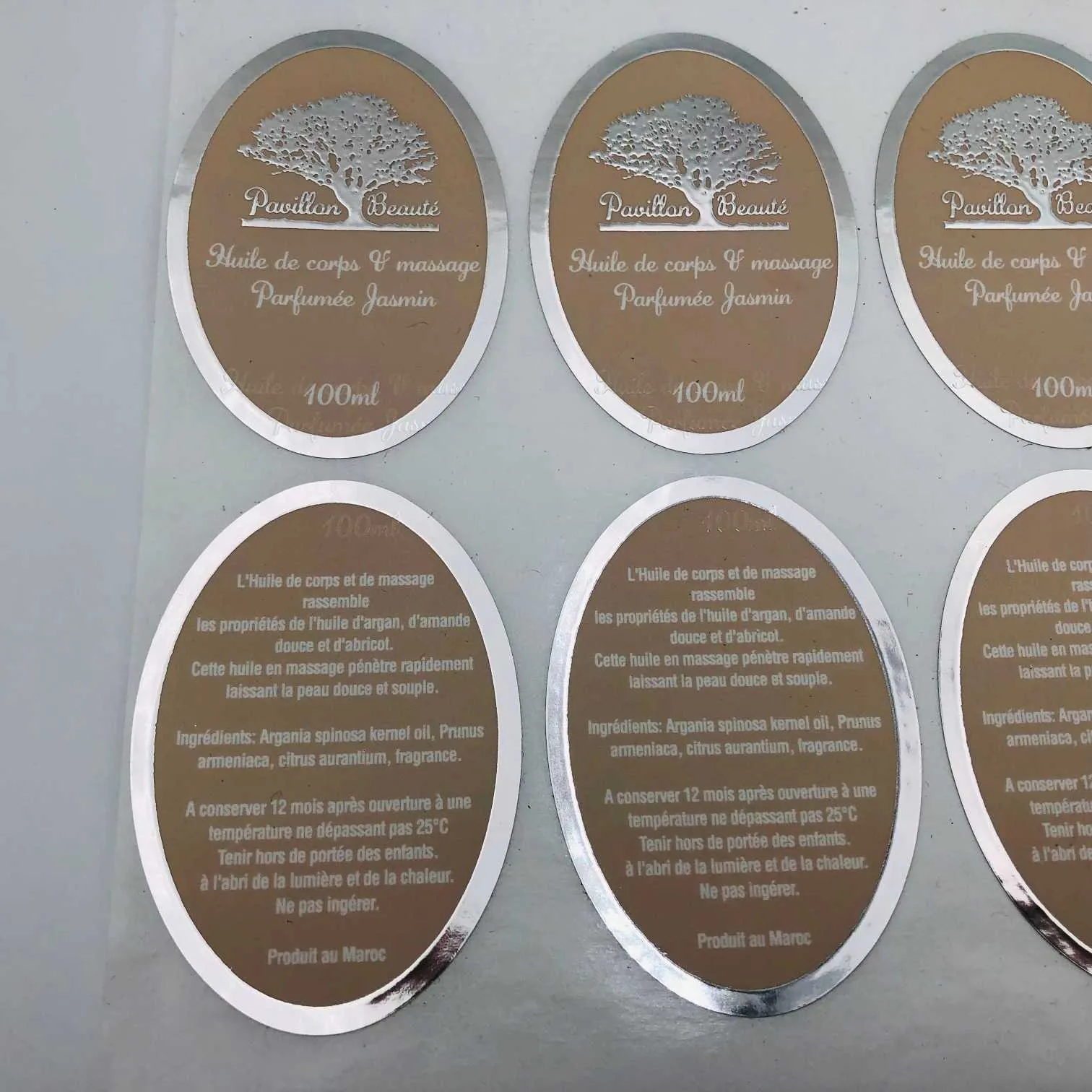
In a crowded retail aisle, packaging has roughly three seconds to communicate value. JOJO works with brands that understand this: the silver foil stamped labels deliver a reflective, metallic finish that reads as premium without the cost of real metal components. Silver foil catches ambient light and shifts in appearance as a shopper moves past—an effect flat inks simply cannot reproduce. For cosmetics, beverages, supplements, electronics accessories, and gift packaging, that visual lift often translates directly into perceived quality and higher willingness to pay.
Silver also carries practical advantages over gold foil. It reads as modern, clean, and technical, which suits skincare, spirits, craft beverages, and hardware products. It pairs naturally with matte black, deep navy, and white substrates, giving designers a flexible palette for both minimal and ornate label styles.
Foil stamping is a dry printing process. A heated metal die is pressed against a thin metallic foil film, transferring the foil layer onto the label substrate exactly where the die contacts it. There is no liquid ink involved, which is why the result holds a true metallic sheen rather than a printed approximation.
The variables that determine final quality:
Because these factors interact, foil stamping is best handled by a supplier with in-house die experience—something worth confirming when comparing quotes.
Foil is unforgiving of design shortcuts. Follow these rules to keep results crisp:
Designers who treat foil as a structural element—not a decorative overlay—consistently get the best results.
The label substrate and adhesive must match both the foil process and the product's environment.
For products sold in humid, oily, or refrigerated conditions, film substrates with a protective laminate over the foil area preserve the metallic look far longer than uncoated paper.
Brands often compare silver foil against metallic ink and cold foil transfer. The table below summarizes the trade-offs.
| Attribute | Silver Foil Stamping | Metallic Ink | Cold Foil Transfer |
|---|---|---|---|
| Reflectivity | High, true metallic mirror effect | Moderate, reads as flat shimmer | High, slightly less intense than hot stamping |
| Edge sharpness | Excellent with quality dies | Good | Good, less crisp on fine detail |
| Fine text capability | Strong at 6 pt and above | Strong | Moderate |
| Texture and emboss combination | Yes, can combine with embossing | No | Limited |
| Setup cost | Requires a metal die | Low | Moderate |
| Best for | Premium logos, luxury packaging | Budget metallic accents | High-volume flexible runs |
| Durability on film | Excellent with protective laminate | Good | Good |
For low-volume projects where a die cost is hard to justify, metallic ink may be pragmatic. For brand-critical logo work and luxury positioning, hot foil stamping remains the benchmark.
Certain product categories gain outsized benefit from silver foil:
A common high-return strategy is to reserve foil for the brand mark and a single accent line, keeping the rest of the label matte. This contrast maximizes the perceived value of the metallic area.
Q1: What are silver foil stamped labels made of?
A: They use a thin metallic foil film transferred onto a paper or film label substrate by a heated die. No liquid metallic ink is involved, which produces the true reflective finish.
Q2: How durable is silver foil on product labels?
A: On coated paper in dry conditions, foil holds well. For bottles, cosmetics, and refrigerated goods, choose a film substrate with a protective laminate over the foil area to resist moisture, oil, and scuffing.
Q3: What is the minimum order quantity for custom foil labels?
A: MOQ depends on die requirements, substrate, and finishing. Simple one-color foil labels on standard stock typically have lower minimums than multi-process labels combining foil, embossing, and spot UV.
Q4: Can foil be combined with embossing or spot UV?
A: Yes. Foil plus embossing is a classic luxury combination, creating a raised metallic surface. Foil plus spot UV on adjacent matte areas creates strong tactile contrast, though registration tolerances must be planned for.
Q5: How should I prepare artwork files for foil stamping?
A: Supply vector artwork with the foil area on a separate layer, use fonts of 6 points or larger, keep minimum line weights around 0.25 mm, and avoid gradients. Include a proof approval step before production.
Q6: Does silver foil cost more than metallic ink?
A: Yes, primarily due to die creation and a separate production pass. The cost is usually justified for logo and brand-mark areas where reflectivity and perceived value matter most.
Q7: Can silver foil be recycled with paper labels?
A: Foil coverage is typically small, so many paper-based foil labels are accepted in standard paper recycling streams, but local rules vary. For film substrates, check with your regional recycling authority.
Silver foil is one of the fastest ways to move a product from "ordinary" to "considered," and the difference lies in die quality, substrate choice, and process control. JOJO specializes in producing the silver foil stamped labels with precise registration, sharp edges, and finishes built to survive real retail and shipping conditions. Whether you need foil seals for a skincare launch, neck labels for a spirits line, or multi-ply labels with a metallic brand mark, our team can advise on artwork preparation, materials, and run sizes that make sense for your budget. Share your artwork and quantity, and we will return a clear quote and production timeline. contact us today to start your foil label project, and let our team help you choose the right combination of substrate, foil, and finishing—contact us now for a sample pack and a tailored recommendation.
-